


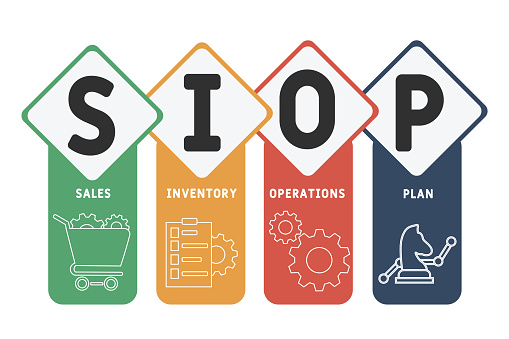
In today’s complex supply-chain environment, companies need more than isolated forecasts or siloed departments. They need a holistic process that connects sales demand, inventory levels and operational capacity. This process is known as Sales, Inventory & Operations Planning, or SIOP.
In simple terms, SIOP synchronizes three critical pillars: what you expect to sell, what you have or plan to hold in stock, and what your operations can deliver. By aligning these elements, businesses are better positioned to meet demand, reduce waste and optimize working capital.
Why SIOP Matters
When sales forecasts, inventory and operations run independently, you often see:
- Stock-outs or lost sales when demand rises unexpectedly.
- Excess inventory that ties up cash and risks obsolescence.
- Operational bottlenecks because production or logistics couldn’t scale.
A well-implemented SIOP approach helps mitigate these issues by:
- Improving forecasting accuracy, enabling more predictable planning.
- Enhancing inventory management, reducing carrying costs and overstock situations.
- Boosting operational effectiveness by ensuring production, warehousing and logistics can keep up with demand.
In many cases, companies that adopt structured SIOP processes will see better service levels and lower costs.
SIOP vs. S&OP vs. IBP
These terms are sometimes used interchangeably, but there are meaningful differences:
- S&OP (Sales & Operations Planning) focuses on aligning what the business will sell (sales forecast) with what it can produce (operations capacity). Inventory often takes a backseat.
- SIOP explicitly integrates inventory into that mix — making sure stock levels are considered alongside sales and operations.
- IBP (Integrated Business Planning) goes even further, linking SIOP or S&OP to full financial planning, strategic goals and enterprise-wide metrics.
In short: SIOP = Sales + Inventory + Operations, while S&OP often omits the “I”, and IBP adds the broader business/financial layer.
Key Components of an SIOP Process
To run SIOP effectively, organizations should focus on these steps:
- Data collection & analysis – Gather sales history, inventory levels, lead times, capacity constraints, supplier information.
- Demand forecasting – Use historical data, market signals and qualitative inputs to estimate future sales.
- Inventory planning – Determine optimal stock levels (how much and when) based on the forecast, lead times and service targets.
- Operations & supply-planning – Confirm production, sourcing, logistics and warehousing capacities align with the demand and inventory plan.
- Cross-functional meeting – Bring together stakeholders (sales, operations, inventory/planning, finance) to align assumptions, review gaps and decide on actions.
- Implementation & monitoring – Execute the agreed plan, track performance (KPIs such as stock-turns, fill-rate, forecast error) and iterate/adjust regularly.
Benefits and Challenges
Benefits
- Greater alignment across departments, fewer silos.
- Lower inventory costs — less overstock & less obsolescence.
- Higher customer satisfaction via better service levels and fewer stock-outs.
- Improved working capital utilization and profitability.
Challenges
- Requires cultural change: all departments must collaborate.
- Needs accurate data and analytics — incomplete or poor-quality data undermines the process.
- Changing from reactive to proactive mindset can be difficult.
- Implementation takes time — results may not be immediate and require disciplined cycles.
Practical Tips for Implementation
- Start small: pilot SIOP on a product line or region before scaling enterprise-wide.
- Define ownership and governance: who leads the monthly meeting, who owns KPIs, who follows up on action items.
- Use reliable tools: spreadsheets may suffice initially, but as complexity grows consider dedicated planning software.
- Review regularly: SIOP should operate on a recurring cycle (e.g., monthly or rolling 12-18 months) rather than as a one-off.
- Focus on continuous improvement: track key metrics (forecast accuracy, inventory turns, service level) and refine the process.
Conclusion
If your business is grappling with mismatches between what you sell, what you hold and what you can deliver, then adopting a structured SIOP process can be a game-changer. By aligning sales, inventory and operations, companies can unlock improved efficiency, stronger customer satisfaction and better financial performance.
The name might be SIOP, but the real value lies in cross-functional alignment, data-driven decisions and execution discipline.