


Pay-per-click (PPC) advertising is one of the fastest ways to drive targeted traffic, generate leads, and increase sales. However, without a well-defined budget, PPC campaigns can quickly become expensive and inefficient. Setting the right PPC budget requires balancing business goals, data, and ongoing optimization.
In this guide, you’ll learn how to set a PPC budget, what factors to consider, and practical tips to make the most of your pay-per-click investment.
What Is a PPC Budget?
A PPC budget is the amount of money you allocate to paid advertising campaigns on platforms like Google Ads, Bing Ads, and social media networks. Your budget determines:
- How often your ads are shown
- How many clicks you can afford
- How competitive your campaigns can be
Effective PPC budgeting ensures you maximize return on investment (ROI) while controlling costs.
Define Your PPC Goals First
Before setting a budget, clearly define your objectives.
Common PPC goals include:
- Increasing website traffic
- Generating leads
- Driving ecommerce sales
- Promoting a new product or service
- Boosting brand awareness
Each goal requires a different budget strategy. For example, lead generation campaigns typically focus on cost per lead (CPL), while ecommerce campaigns prioritize return on ad spend (ROAS).
Understand Your Key Metrics
Data-driven budgeting starts with understanding essential PPC metrics.
Key metrics to track:
- Cost Per Click (CPC)
- Conversion Rate
- Cost Per Acquisition (CPA)
- Return on Ad Spend (ROAS)
- Click-Through Rate (CTR)
Knowing these numbers helps you estimate how much budget is needed to achieve your goals.
Calculate Your Initial PPC Budget
A simple formula to estimate your PPC budget:
Target conversions × Cost per acquisition = Monthly PPC budget
Example:
- Target: 100 leads per month
- CPA: $25
- Monthly budget: $2,500
This approach ensures your budget is aligned with performance expectations rather than guesswork.
Factor in Keyword Competition
Keyword competitiveness significantly impacts PPC costs.
Consider:
- High-intent keywords usually cost more
- Branded keywords are often cheaper and convert better
- Long-tail keywords reduce CPC and improve targeting
Balancing competitive and long-tail keywords helps control costs while maintaining reach.
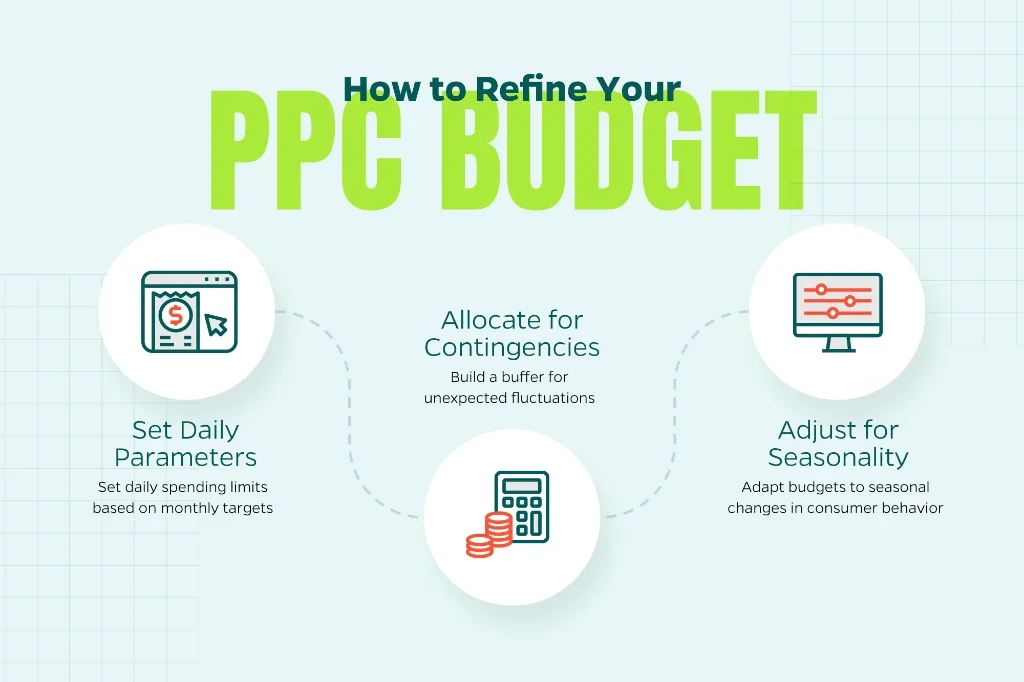
Set Daily and Monthly Limits
Most platforms allow you to set both daily and monthly budgets.
Best practices:
- Start with a conservative daily budget
- Scale gradually based on performance
- Avoid spending too much too fast before collecting data
Controlled scaling reduces wasted ad spend and improves efficiency.
Allocate Budget by Campaign and Channel
Not all campaigns deserve equal funding.
Tips:
- Allocate more budget to high-performing campaigns
- Separate brand, non-brand, and remarketing campaigns
- Test different channels (search, display, social)
- Shift budget based on ROI, not assumptions
Continuous reallocation ensures better results over time.
Include a Testing Budget
Testing is essential for long-term PPC success.
Allocate 10–20% of your budget to:
- A/B testing ad copy
- Experimenting with new keywords
- Testing landing pages
- Trying new platforms or formats
Testing helps uncover opportunities for growth and optimization.
Monitor, Optimize, and Adjust Regularly
PPC budgeting is not a one-time task.
Ongoing optimization includes:
- Pausing underperforming ads
- Adjusting bids and targeting
- Refining keyword lists
- Improving Quality Scores
Regular monitoring ensures your budget is spent efficiently.
Common PPC Budgeting Mistakes to Avoid
- Setting a budget without clear goals
- Ignoring performance data
- Overspending on low-intent keywords
- Not accounting for seasonality
- Failing to optimize landing pages
Avoiding these mistakes can significantly improve campaign profitability.
Conclusion
Setting a PPC budget requires a strategic, data-driven approach. By defining goals, understanding key metrics, allocating budget wisely, and continuously optimizing, businesses can maximize results while maintaining cost control.
With the right budgeting strategy, PPC becomes a scalable and predictable growth channel.